
Choosing a commercial roof is not only a material decision. The right system has to work with the building, the roof deck, drainage, rooftop equipment, weather exposure, maintenance expectations, and the owner’s plans for the property. For Florida owners comparing commercial roofing systems in Florida, the most useful starting point is understanding how the major low-slope options differ rather than looking for one system that is automatically best. Our commercial roofing services include multiple systems because different buildings call for different solutions.
That matters whether a property is being built, re-roofed, or evaluated after years of service. A warehouse with frequent rooftop traffic may have different priorities from a restaurant, retail center, office building, or light-industrial facility. Property owners researching commercial roofing in St. Petersburg should therefore compare assemblies by how they perform in the actual building context, not just by a list of product features. TPO, EPDM, PVC, and built-up roofing each solve the same basic problem in a different way.
Start With the Building, Not the Roofing Material
A roof system begins below the exposed membrane. Deck type, insulation, attachment method, slope, drainage, penetrations, parapets, and existing materials all affect what can be installed and how the finished roof will perform. The U.S. Department of Defense roof system materials guidance groups EPDM and PVC under membrane single-ply systems while treating built-up roofing as a multi-ply category, which illustrates that these choices are fundamentally different assemblies rather than interchangeable sheets placed on top of a building.
The existing condition also changes the decision. A sound deck with effective drainage gives a roofing contractor more options than a roof with wet insulation, widespread deterioration, or structural concerns. Owners should also consider where mechanical equipment is located, how often technicians walk the roof, whether grease or chemical exposure is possible, and whether the building will remain occupied during the project. Those practical details often matter more than a broad claim that one material lasts longer or costs less.
Wind exposure and code requirements also belong in the early design conversation. Florida projects may need system-specific fastening, edge securement, and uplift ratings based on location, building height, deck type, and other conditions. Those requirements can affect membrane thickness, attachment spacing, insulation layout, and perimeter detailing. Owners should expect the contractor and designer to connect the selected roof system with the applicable manufacturer approvals and local requirements rather than relying on a generic installation approach.
TPO Roofing: Reflective Single-Ply Performance
TPO is a thermoplastic single-ply membrane commonly used on flat and low-slope commercial buildings. White and other light-colored TPO membranes can provide high solar reflectance, which can reduce the amount of solar heat absorbed at the roof surface. GAF describes TPO as a heat-welded single-ply membrane designed for low-slope roofing, with resistance to heat and ultraviolet exposure among its intended performance characteristics. Property owners can review the manufacturer’s TPO membrane overview when comparing how this class of system is constructed and detailed.
TPO seams are welded with hot air rather than joined with tape, so installation quality at seams, penetrations, edges, and transitions is central to the finished system. Attachment may be mechanical, adhered, or part of a recover assembly depending on the roof design and manufacturer requirements. The membrane itself is only one layer in the system, so insulation, cover boards, fastening patterns, drainage, and substrate preparation still require project-specific decisions. A bright membrane should not be treated as a substitute for adequate insulation or correct roof design.
TPO can be particularly attractive on large roof areas where a continuous light-colored surface is desired, but the field membrane is only part of the detailing burden. Curbs, drains, pipe penetrations, expansion joints, walls, and edge transitions all interrupt the field of the roof and must be integrated into the membrane system. Future equipment replacement should also be considered because cutting and patching a roof repeatedly can introduce avoidable maintenance points if access and service paths are not planned.
EPDM Roofing: Flexible Rubber Membrane
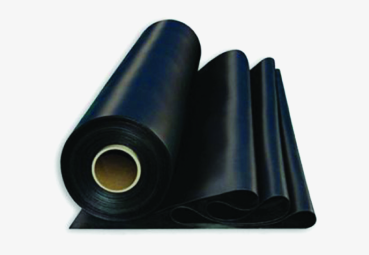
EPDM is a synthetic rubber membrane with a long history in low-slope roofing. It is flexible and is commonly available in large sheets, which can reduce the number of field seams on some roof layouts. Unlike the white surfaces often associated with TPO and PVC, traditional EPDM is black, although reflective options and coatings may be available within particular systems. That difference can influence surface temperature, but it does not by itself determine whether EPDM is appropriate for a building.
EPDM assemblies may be fully adhered, mechanically attached, or ballasted depending on the system design. Seams and details are typically completed with adhesives, primers, tapes, and compatible accessories rather than hot-air welding. Owners should think about rooftop traffic, service access, puncture risk, drainage, and maintenance practices when considering EPDM. The best choice is the one whose complete assembly fits the deck, building use, wind requirements, and long-term maintenance plan.
The darker surface of standard EPDM can be appropriate when reflectivity is not the controlling objective, and its flexibility can be useful around complex roof geometry. Owners should still review how the membrane will be protected near access routes and mechanical equipment. Walkway pads, clear service paths, and disciplined coordination with HVAC or electrical contractors can reduce accidental damage. Those operational choices influence roof performance long after the initial installation crew has left the site.
PVC Roofing: A Different Thermoplastic Option
PVC is another thermoplastic single-ply membrane, so it shares some installation concepts with TPO, including hot-air welded seams. Its formulation is different, however, and certain PVC products are designed for strong resistance to chemicals and grease. That can make PVC worth evaluating for restaurants, food-processing facilities, and other buildings where rooftop exhaust or process-related exposure may be a concern. Sika’s PVC roofing membrane information also identifies high reflectivity and hot-air welded seams as product characteristics.
Compatibility is important with PVC because roofing materials, adhesives, insulation, and existing substrates must be selected as a system. Some PVC membranes require separation from incompatible materials, so a retrofit or recover project cannot be planned by simply placing a new membrane over whatever is already on the roof. A contractor should verify the manufacturer’s requirements and the existing assembly before specifying the new roof. This is especially important on older buildings where past repairs may have introduced several different materials.
Built-Up Roofing: Multi-Layer Protection
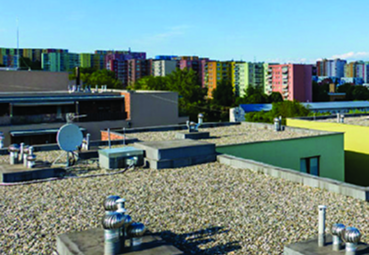
Built-up roofing, often shortened to BUR, takes a different approach from single-ply membranes. The Asphalt Roofing Manufacturers Association defines BUR as multiple layers of asphalt alternated with ply sheets, usually installed over the roof deck and insulation. Its built-up roofing overview explains how the layers create a water-resistant membrane and provide redundancy within the roof assembly. That multi-layer construction is one reason BUR remains relevant for commercial properties that value a robust surface.
Surfacing can vary, with gravel, mineral surfaces, or coatings used depending on the system. The added layers can create a durable assembly, but the roof structure, installation method, drainage, and project logistics have to support it. For owners comparing flat roofing services in St. Petersburg, this is a useful reminder that flat and low-slope roofs are not one product category. A BUR system may suit one building while a lighter single-ply assembly may be a better fit for another.
Compare the Systems Against Long-Term Property Goals
Material selection becomes clearer when owners compare the systems against a consistent set of questions. How sound is the existing deck? Does the roof have positive drainage? How much rooftop traffic occurs? Are there grease, chemical, or exhaust exposures? Is reflectivity a priority? How easily can future repairs be completed? Will the building remain occupied during the work? These questions turn a generic product comparison into a building-specific decision.
Maintenance expectations should be part of that comparison from the beginning. Every commercial roof needs periodic inspection of seams or laps, flashings, penetrations, drains, edge conditions, and damage caused by weather or service work. Some systems may be easier to patch in a particular setting, while others may provide greater redundancy or a surface better suited to specific exposures. Owners should also consider manufacturer requirements, local code conditions, wind design, and whether future rooftop equipment changes are likely.
Choosing the Right Commercial Roofing System for the Property
No roofing membrane can compensate for a poor match between the system and the building. Owners planning roof installation in Fort Lauderdale should begin with an assessment of the existing roof, deck, drainage, and operating needs before narrowing the material list. The same principle applies to replacement work elsewhere in Florida, especially where weather exposure and occupied-building logistics can shape the project.
A professional roofing contractor in Fort Lauderdale should be able to explain why a particular assembly fits the property rather than simply naming a preferred product. The evaluation should connect material characteristics with the roof’s actual condition, attachment requirements, drainage, insulation, service access, and maintenance plan.
At Rhino Commercial Roofing, we work with TPO, EPDM, PVC, built-up roofing, metal systems, coatings, repairs, inspections, and related commercial roofing needs across Florida. Our roof inspection services can help identify the conditions that should guide a roofing decision before work begins. To compare suitable options for your property, explore our commercial roofing services.